

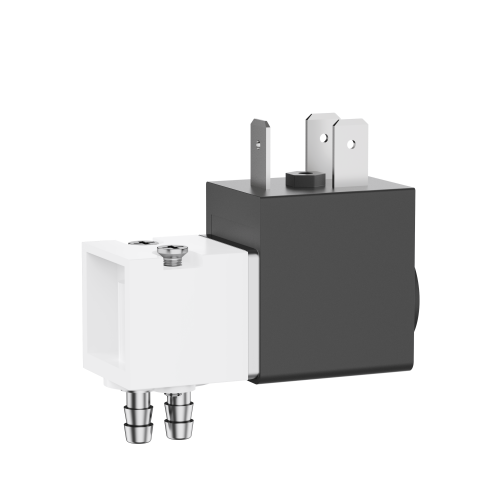
In the hydrogen energy industry, low pressure applications such as fuel cell auxiliary circuits, hydrogen safety monitoring, and low-pressure hydrogen storage are key links ensuring overall safe and efficient operation. The core fluid control requirements for these scenarios are “stable low-pressure sealing, fast and accurate response, and wide temperature range adaptation”. J-Tron’s DC Solenoid Valve customized for low-pressure hydrogen energy scenarios, with core advantages of “-0.8~4bar operating pressure, 30ms response time, 0~60°C wide temperature adaptation, and no leakage at 6bar air pressure”, has become the preferred component for low-pressure hydrogen system. As a manufacturer specializing in micro liquid control component, J-Tron combines parameter analysis and industry popular science to interpret the adaptation value of solenoid valves in low-pressure hydrogen energy scenarios.

1. -0.8~4bar Operating Pressure: Accurately Covering Core Low-Pressure Scenarios in Hydrogen Energy
The pressure requirements of low-pressure hydrogen energy scenarios are concentrated in the -0.8~4bar range. Traditional solenoid valves often have scenario limitations due to narrow pressure adaptation ranges, while J-Tron's mini solenoid valve pressure parameters perfectly match three core scenarios:
Fuel Cell Auxiliary Circuits: The pressure of coolant circulation and air supply circuits in fuel cell systems is usually 0.5~2bar. The -0.8~4bar pressure range of J-Tron's solenoid valves can easily cover this, enabling stable operation under negative pressure conditions (e.g., system vacuuming) and coping with circuit pressure fluctuations (e.g., pressure rising to 3~4bar due to load changes) to avoid valve failure;
Low-Pressure Hydrogen Storage/Transportation: Small fixed hydrogen storage tanks (e.g., 50L laboratory storage tanks) and low-pressure buffer tanks in on-board hydrogen systems have an operating pressure of mostly 1~3bar. Solenoid valves need to achieve "no leakage during on-off" under this pressure. The rated pressure upper limit of J-Tron's solenoid valves reaches 4bar, providing safety redundancy and complying with GB/T 3634.2 hydrogen system safety standards;
Hydrogen Safety Monitoring Circuits: The sampling gas path pressure of hydrogen leakage detection systems is usually -0.3~0.5bar (negative pressure sampling). The -0.8bar negative pressure adaptation capability of J-Tron's solenoid valves ensures smooth sampling gas paths and prevents valve failure due to negative pressure, guaranteeing real-time leakage monitoring.
Popular Science: Although low-pressure hydrogen energy scenarios have no high-pressure explosion risks, negative pressure can easily suck in air to form a hydrogen-air mixture (concentrations of 4%-75% still pose explosion hazards). Therefore, the negative pressure sealing stability of solenoid valves is as important as positive pressure.

2. 30ms Ultra-Fast Response: Matching Dynamic Control Needs of Low-Pressure Hydrogen Systems
Low-pressure hydrogen energy systems have strict requirements for fluid switching response speed: for example, when the coolant temperature of fuel cells exceeds 60°C, solenoid valves need to quickly open to introduce low-temperature coolant; when hydrogen leakage is detected by the safety monitoring system, the sampling gas path must be immediately cut off to prevent mixture diffusion. These scenarios all require a response time ≤50ms. J-Tron's min solenoid valve achieves 30ms ultra-fast response through "drive optimization + structural lightweighting".
Popular Science: For every 10ms reduction in solenoid valve response time, the safety emergency disposal efficiency of hydrogen systems can be increased by 20%, which is particularly important for enclosed on-board hydrogen systems and laboratory hydrogen environments.
3. 0~60°C Temperature Range Adaptation: Coping with Temperature Fluctuations in Hydrogen Energy Scenarios
The temperature environment of low-pressure hydrogen energy scenarios is mostly in the 0~60°C range: the ambient temperature of on-board hydrogen systems changes with the outside (reaching 55~60°C in the car in summer), the coolant temperature of fuel cell auxiliary circuits is usually 40~60°C, and the laboratory hydrogen storage environment temperature is 10~30°C. Solenoid valves need to maintain stable performance within this temperatuzre range. J-Tron's 24V DC solenoid valve achieves 0~60°C wide temperature adaptation.